How to Build a Tech Research Analyst Agent
An AI agent that analyzes technology trends and identifies emerging trends or competitors.
Connectors and tools
Google Docs
Firecrawl
Notion
Created by
xpander.ai
Built for
Defense and government companies
Competitive intelligence teams
Enterprise market research teams
Useful links
Challenge
This AI agent addresses the difficulty enterprises face in manually processing large, complex technology datasets. Specifically, it solves the problem of efficiently extracting actionable intelligence—such as emerging trends and competitive threats—from unstructured data sources. This automation replaces a process that is typically time-consuming and prone to human oversight, streamlining deployment of research capabilities.
How the AI agent works
Below is how the agent works:
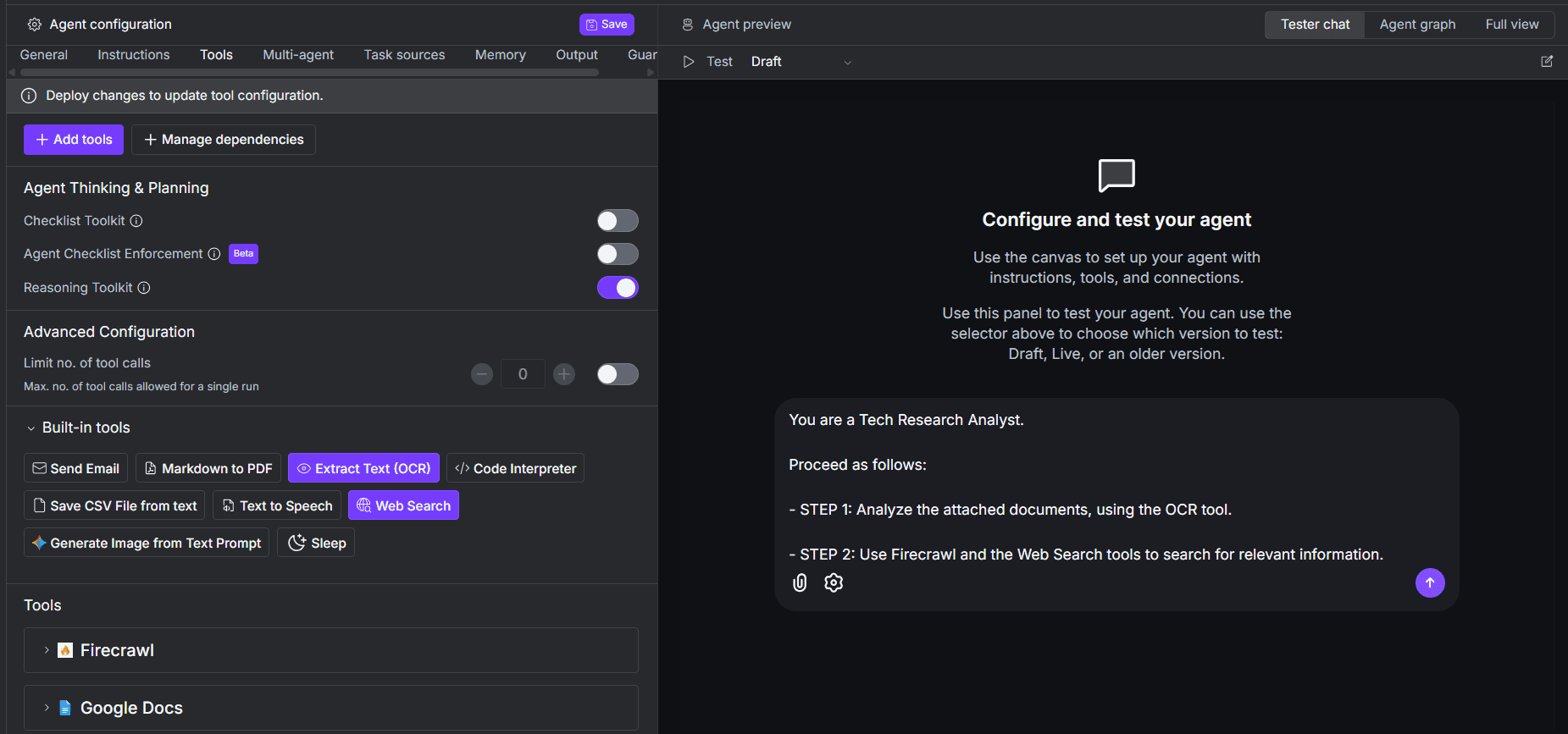
1. File upload and processing: The process begins with the user uploading a report or dataset. The system automatically handles data ingestion, including running OCR for scanned documents. This ensures all relevant content is available for the AI agent framework to process.
2. Web search query generation: An advanced AI model equipped with Firecrawl web search reviews the uploaded dataset and generates a concise, focused query. This step allows for autonomous query generation designed to surface the latest patents and publications. The LLM summarizes key terms, ensuring the workflow is both comprehensive and targeted.
3. Professional report formatting: The AI model receives findings from and assembles them into a coherent report. The output is plain text, suitable for production use in documents and further sharing.
Key benefits
- Accelerated deployment: Pre-built templates allow developers to move AI agents from prototype to production faster, reducing the time spent on initial setup and configuration.
- Seamless orchestration: The platform handles the complex orchestration of LLMs and external tools (like Firecrawl and Google Docs), simplifying the management of the whole workflow.
- Enterprise-grade scalability: Designed for enterprise use, the architecture supports processing large datasets and can scale to handle high-volume document analysis without performance degradation.
- Customizable frameworks: The system allows for deep customization of prompts and logic, enabling developers to adapt best practices and specific analytical frameworks (like JTBD) to their unique business needs.
Frequently Asked Questions
Expand all