How to Build a Newsletter Writer Agent
An AI agent that searches the knowledge base, extracts key information, and drafts a professional newsletter.
Connectors and tools
Google Docs
Google Drive
Notion
Created by
xpander.ai
Built for
Software companies who need to develop newsletter fast
Marketing teams
Challenge
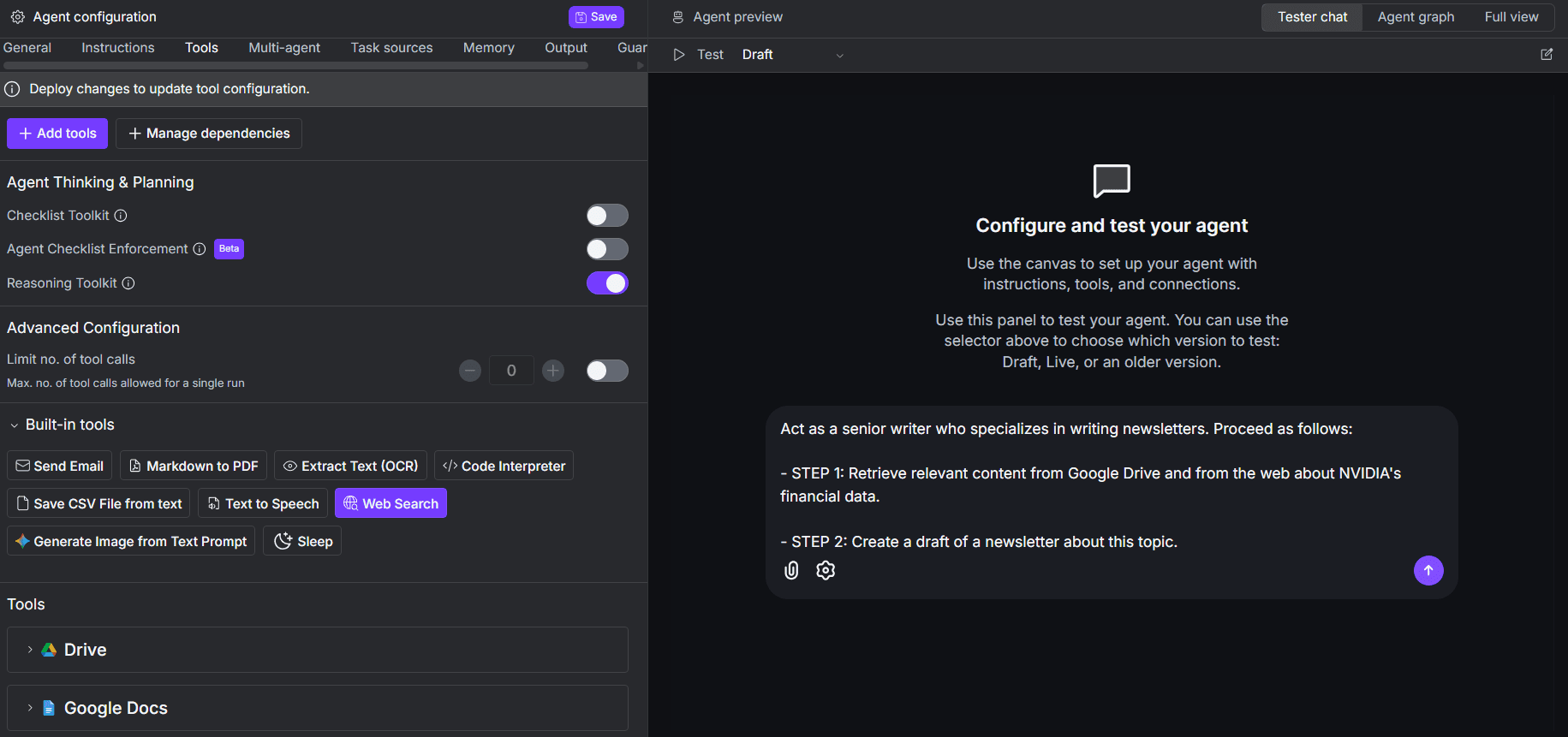
This agent solves the challenge of fragmented data retrieval and manual synthesis in high-stakes enterprise communications. Creating newsletters typically requires an analyst to context-switch between hunting for specific internal files and digesting external market intelligence. By leveraging automation to handle the extraction, summarization, and structural orchestration of these disparate information streams, the agent eliminates the bottleneck of manual data gathering and analysis. This allows the user to focus on refinement rather than drafting from scratch, showcasing the power of tools to build AI for production workflows
How the AI agent works
Below is how the agent works:
1. User input: The user types keywords or topics to guide the automation of the newsletter’s focus..
2. Data retrieval: The agent uses the user’s input to search for relevant product documents in Google Drive and online content, utilizing secure enterprise protocols.
3. Content generation: The agent summarizes product updates using information from the product documents, leveraging advanced agent frameworks for context understanding.
4. Newsletter assembly: The agent composes the full newsletter by combining the outputs of all the documents and content it retrieved. It also sets up to send the newsletter to Google Docs, acting as a powerful tool to build AI workflows that connect directly to productivity apps.
Key benefits
- Streamlined enterprise automation: By consolidating fragmented manual tasks into a single cohesive workflow, the agent drastically reduces the time required to draft newsletters. This level of automation allows enterprise teams to shift focus from repetitive data gathering to high-value strategic analysis.
- Production-ready deployment: Designed for immediate deployment in high-stakes environments, the agent moves beyond simple prototyping. It offers a stable, production-grade solution that handles real-world data variability and formatting requirements reliably.
- Scalable data processing: The architecture allows for parallel processing. This capability is essential for scaling operations, ensuring the agent remains responsive even when processing large datasets when integrated in complex workflows.
Frequently Asked Questions
Expand all