
There’s a question I keep hearing from enterprise leaders: “We’ve deployed a few AI agents. Now what?”
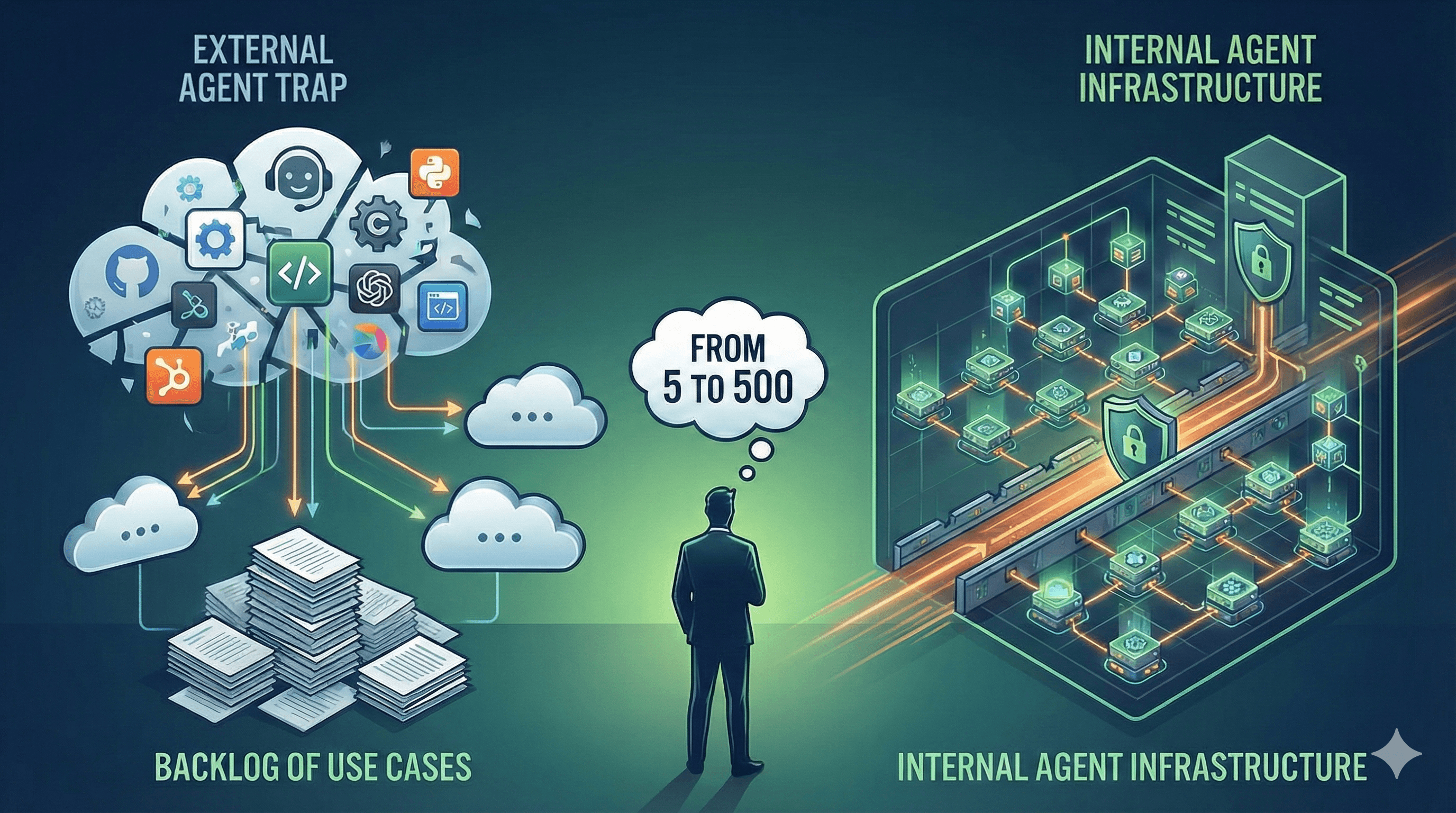
They’ve piloted a customer service bot, automated a workflow or two, maybe integrated a coding assistant. Each one required a separate vendor, a separate integration, a separate security review. And now they’re staring at a backlog of 200 more use cases, wondering how they’ll ever get there.
This is the moment where the difference between agents and agent infrastructure becomes painfully clear.
The External Agent Trap
Most AI agents on the market today are external. They operate like any other SaaS vendor: your data goes out, their magic happens, results come back. They’re vertical solutions: one agent for sales, another for support, another for code review.
For a single use case, this works fine. For ten use cases, it’s manageable. For a hundred? You’ve just created a sprawling ecosystem of point solutions, each with its own security model, its own data policies, its own integration debt.
And here’s the harder truth: external agents can’t touch your most valuable workflows. The ones that require access to sensitive systems. The ones that need to run for days, not seconds. The ones that must operate in environments that can’t reach the public cloud.
Internal Agents: A Different Architecture
Internal agents run inside your environment. They use your permissions, your APIs, your security boundaries. They don’t ask you to trust a third party with your data—they operate as an extension of your own infrastructure.
This isn’t just a deployment preference. It’s an architectural decision that unlocks an entirely different scale of possibility.
When agents run internally, you can deploy them against workflows that would never be approved for external processing. You can let them run for hours, days, or weeks on complex tasks. You can operate them in air-gapped environments, in regulated industries, in scenarios where data residency isn’t negotiable.
Most importantly, you can standardize. One infrastructure layer. One security model. One integration pattern. Hundreds of use cases.
The Real Question: One Agent or One Hundred?
If you only need one or two AI agents, buy the best point solutions and move on. Seriously. There are excellent vertical agents out there, and for narrow use cases, they’ll serve you well.
But if you’re thinking about AI agents as a strategic capability (something that should eventually touch every department, every workflow, every process that involves repetitive decision-making), then you need to think about infrastructure.
Because the gap between “we have 5 agents” and “we have 500 agents” isn’t filled by buying more products. It’s filled by building the foundation that lets you create, deploy, and manage agents at scale, with the control and security your organization requires.
What Infrastructure Actually Means
When we talk about agent infrastructure, we mean something specific. Not a framework that replaces your development tools. Not a platform that locks in your code. Not an abstraction layer that hides what’s happening underneath.
True infrastructure is foundational and non-invasive. It provides the runtime, orchestration, and operational capabilities that agents need—without dictating how you build them. Your developers keep full control of their code. Your security team keeps full visibility into what’s running. Your operations team gets the observability and management tools they need.
And for teams that don’t write code, infrastructure means templates and patterns that generate production-ready agents from proven building blocks—not black boxes, but transparent, auditable, customizable starting points.
The Path to Hundreds of Use Cases
Organizations that successfully scale AI agents don’t do it by evaluating hundreds of vendors. They do it by making a foundational investment in how agents will run across their enterprise.
They ask different questions: What’s our standard for agent security? How do we handle long-running tasks? What’s our approach to agent observability? How do we enable teams to build their own agents safely?
These are infrastructure questions. And answering them once, correctly, is what separates organizations that pilot AI agents from organizations that operationalize them.
The enterprises that will lead in the agent era aren’t the ones that adopt the most agents. They’re the ones that build the foundation to deploy agents wherever they’re needed: internally, securely, and at scale.


